Self-Evolving Planning via Test-Time Memory
Stanford University · UC San Diego
Abstract
Reliable object manipulation requires understanding physical properties that vary across objects and environments. Vision-language model (VLM) planners can reason about friction and stability in general terms; however, they often cannot predict how a specific ball will roll on a particular surface or which stone will provide a stable foundation without direct experience. We present PhysMem, a memory framework that enables VLM robot planners to learn physical principles from interaction at test time, without updating model parameters. The system records experiences, generates candidate hypotheses, and verifies them through targeted interaction before promoting validated knowledge to guide future decisions. A central design choice is verification before application: the system tests hypotheses against new observations rather than applying retrieved experience directly.
Presentation
Overview of PhysMem
Method
Inspired by the scientific method, PhysMem transforms raw interaction experiences into verified physical principles through a four-stage loop.
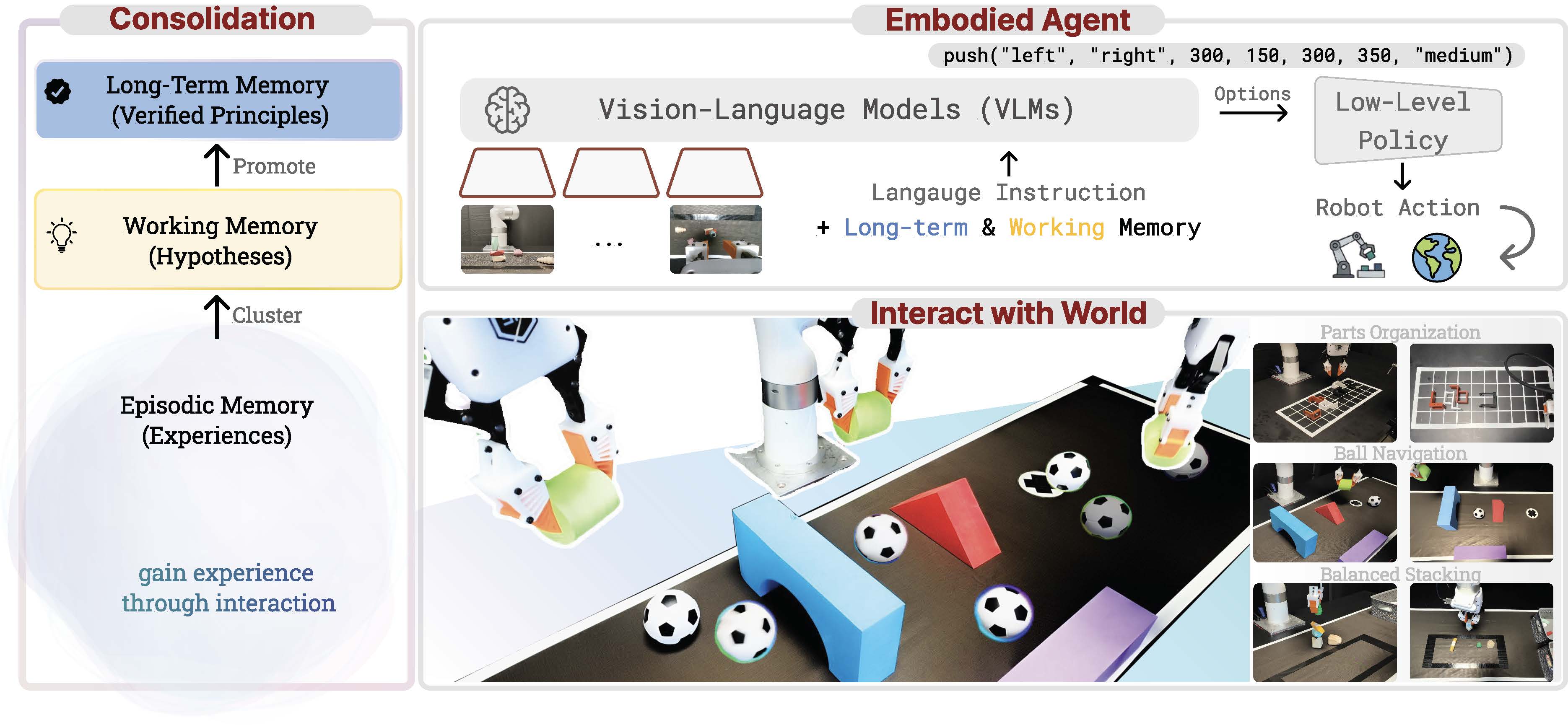
System overview. Left: A three-tier memory system stores raw experiences, clusters them into testable hypotheses, and promotes verified knowledge as principles. Right: The VLM agent retrieves principles and hypotheses from memory to guide planning.
Gather interaction experiences: visual observations, actions taken, and their outcomes.
Generate candidate physical principles from patterns observed in collected experiences.
Validate hypotheses through action-level outcome attribution across multiple trials.
Verified principles join persistent memory, guiding all future planning decisions.
Demonstrations
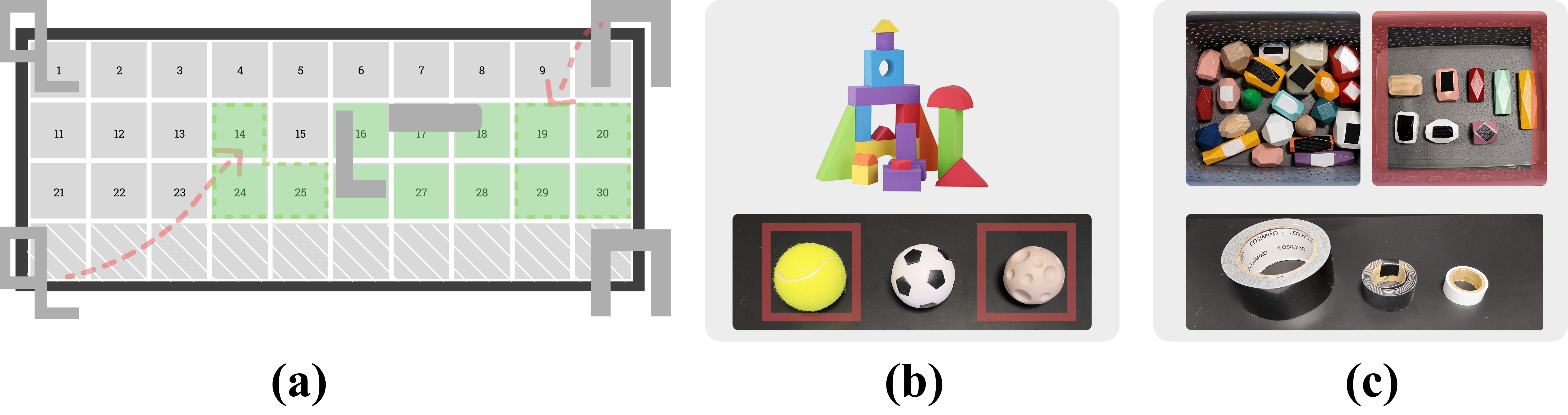
PhysMem is evaluated on three physically challenging manipulation tasks requiring understanding of contact physics, momentum, and stability.
Arrange irregularly shaped objects into a target configuration, requiring understanding of geometry and contact physics.
Guide a ball to a target location by pushing, requiring grasp of momentum and friction dynamics.
Stack objects to achieve balance, demanding knowledge of center-of-mass and stability principles.
Results
3.3× improvement over the strongest VLM baseline
Performance improves steadily as PhysMem accumulates verified principles from each interaction trial.
Principles discovered by one VLM transfer to others — physical knowledge is model-agnostic.
All learning happens in context — no fine-tuning, no gradient updates, no retraining required.
Learned principles generalize to out-of-distribution scenarios with novel materials, masses, and environments.
Comparison
Side-by-side comparison showing how PhysMem's learned principles transform task performance.
Generalization
PhysMem's principles generalize to unseen material properties, object masses, and even lunar gravity.
Citation
@article{li2025physmem,
title = {Learning Physical Principles from Interaction:
Self-Evolving Planning via Test-Time Memory},
author = {Li, Haoyang and You, Yang and Su, Hao and Guibas, Leonidas},
journal = {arXiv preprint arXiv:2602.20323},
year = {2025}
}